
 There’s a unique thrill that hums beneath the surface of every aspiring rocketeer. It starts quietly, perhaps with a childhood memory of a model rocket arcing against a summer sky, or maybe a fascination with space exploration that never quite faded. For me, it was that persistent hum, a quiet yearning to not just watch rockets, but to build them, to send something I crafted soaring towards the heavens. That’s what ultimately led me to the National Association of Rocketry (NAR) and the incredible journey to achieving my Level 1 certification.
The Spark of Inspiration: More Than Just a Kit
When I first looked into high-power rocketry, the idea of building a rocket that could reach hundreds or even thousands of feet seemed daunting. I had no prior experience with aerospace engineering, no specialized tools, and honestly, not much more than a vague understanding of thrust and drag. But the NAR community, which we are proud to be a resource for, is built on encouragement and education. They show you that the biggest skill you need to start is simply curiosity.
The inspiration for a Level 1 rocket isn’t about reinventing the wheel; it’s about understanding the fundamentals. It’s about taking raw materials – a sturdy body tube, precision-cut fins, a robust motor mount, and a carefully designed nose cone – and bringing them together with a purpose. It’s about envisioning that moment when your creation leaves the launch pad, a testament to your patience and newfound understanding.
The General Process: A Hands-On Education
My Level 1 build began with selecting a suitable kit. This is where that initial lack of skills transforms into a rapid learning curve. Each step, meticulously outlined in the instructions, became a mini-lesson in practical engineering:
-
Understanding the Components: From fin can assemblies to recovery systems, I learned the name and function of every part. What’s a shock cord? How does an altimeter work? What’s the difference between a motor retainer and a thrust ring? Each question led to an answer, building a foundational vocabulary.
-
Precision and Adhesion: Attaching fins might seem simple, but ensuring they are perfectly aligned and securely epoxied is crucial for stable flight. I learned the importance of jigs, proper mixing ratios, and generous curing times. Every careful application of epoxy was a lesson in structural integrity.
-
Electronics Integration (The Brains!): Installing an altimeter and understanding its role in deploying the recovery system was a fascinating challenge. Wiring, battery placement, and understanding deployment charges introduced me to basic electronics in a very tangible way.
-
The Recovery System: Packing a parachute or streamer correctly is an art form. It needs to be tight enough to fit, yet loose enough to deploy smoothly at apogee. This stage taught me about practical mechanics and the critical importance of a safe return.
-
Finishing Touches: Sanding, priming, and painting aren’t just cosmetic; they contribute to aerodynamics. A smooth finish reduces drag, ensuring a higher, more stable flight. This was where my rocket truly started to look like the high-flying machine I envisioned.
The beauty of this process is that you don’t need to be an expert to begin. You become one, step by painstaking step. Each successful bond, each perfectly aligned fin, each correctly wired component builds confidence and deepens your understanding of aerodynamic principles, structural engineering, and even basic electronics.
The Moment of Truth: A Symphony of Fire and Air
Then comes launch day. The air crackles with anticipation. You meticulously prepare your rocket, securing the motor, checking the igniter, and performing a final visual inspection. You carry it to the launch pad, feeling the weight of your creation, a tangible representation of hours of work and learning.
As the countdown begins, your heart races. “5… 4… 3… 2… 1… Ignition!“
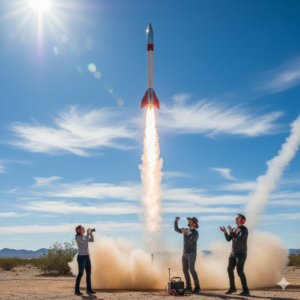
A plume of fiery exhaust erupts from the motor, and with a thunderous roar, your rocket leaps skyward. It’s an almost primal experience. The acceleration is incredible, a straight arrow piercing the blue. You watch it shrink to a dot, then vanish, leaving only a white contrail as it reaches its apogee.
For a Level 1 rocket, achieving an altitude of 800 to 1,500 feet is a common and exhilarating target. And when that ejection charge fires, a puff of smoke marking the deployment of the parachute, and your rocket gently drifts back to earth – the sense of accomplishment is immeasurable.
Beyond Level 1: The Sky’s No Longer the Limit
Achieving NAR Level 1 is more than just getting a certification; it’s earning your wings. It’s a validation of your dedication, your learning, and your ability to bring a complex project to a successful conclusion. It opens the door to Level 2 and Level 3 certifications, each offering new challenges, larger motors, and even higher altitudes.
If you’ve ever felt that quiet hum of inspiration, that desire to build and launch something truly impressive, then high-power rocketry with the NAR is an experience you won’t forget. We are a proud resource for those interested in learning more about NAR and achieving their Level 1, 2 or 3 high power rocketry certifications. Let us help you turn your cardboard dreams into high-flying reality.
What are you waiting for? Your adventure to the skies begins now!